Temporary Operating Permit LTO: Complete Guide for Filipino Drivers
A Temporary Operator’s Permit (TOP) is a paper document issued by the Land Transportation Office that allows you to drive legally for up to 72 hours after your license has been confiscated due to a traffic violation. According to LTO data, over 2.3 million traffic violations were recorded in 2023, with thousands of drivers receiving TOPs daily. Understanding how this permit works protects your right to drive and helps you avoid additional penalties while resolving your violation.
What Is a Temporary Operator’s Permit and When Do You Get One?
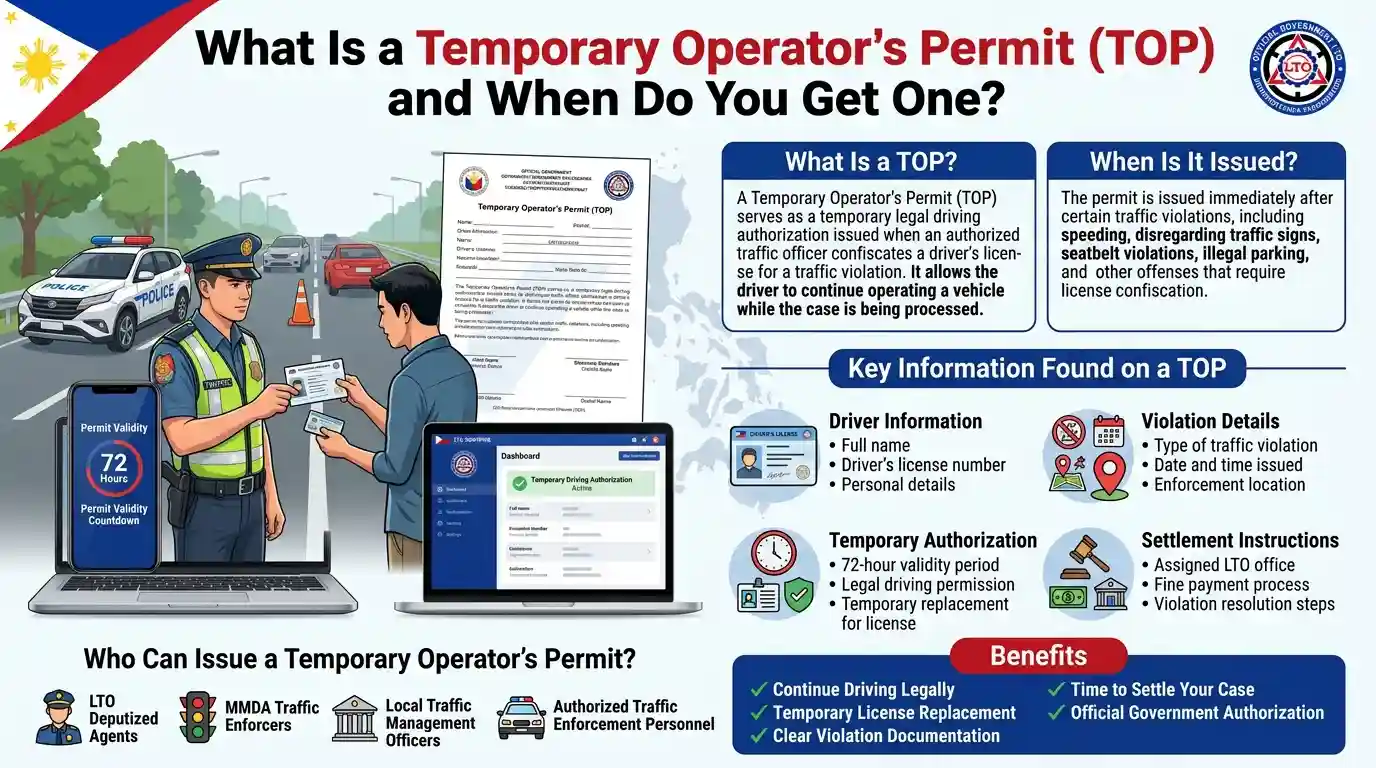
The temporary operator’s permit LTO issues serves as your legal driving authorization for 72 hours after traffic enforcers confiscate your driver’s license. You receive this permit immediately when an authorized officer takes your license for violations like speeding, disregarding traffic signs, driving without a seatbelt, or illegal parking.
The permit contains your name, license number, the specific violation committed, the date and time of issuance, and the LTO office where you must settle your case. Think of it as a temporary replacement that keeps you mobile while your violation is being processed.
Only authorized personnel can issue a TOP. These include LTO deputized agents, Metropolitan Manila Development Authority (MMDA) enforcers in Metro Manila, and local traffic management officers in cities and municipalities nationwide.
Tip:
Take a photo of your TOP immediately after receiving it. This serves as backup documentation if the physical copy gets lost or damaged during the 72 hours.
How Many Hours Does a Temporary Operator’s Permit Last?
The temporary operator’s permit validity is exactly 72 hours from the moment of issuance, giving you three full days to settle your violation at the designated LTO office. The countdown starts the minute the enforcer writes the date and time on your permit.
Here’s what the timeline looks like:
| Time Period | Status | Action Required |
|---|---|---|
| 0-72 hours | Valid driving period | Drive to LTO office, settle violation |
| After 72 hours | Permit expires | Cannot drive legally until license is returned |
| Beyond 1 week | Additional penalties may apply | Risk of license suspension |
The 72-hour window is strict. If you’re caught driving after your TOP expires, you’re essentially driving without a valid license. This means another violation, additional fines, and possible impounding of your vehicle.
The temporary operator’s permit hours don’t extend over weekends or holidays. If your permit expires on a Saturday and LTO offices are closed, you cannot drive until Monday when you can settle your case.
What Are the Different Types of Temporary Operator’s Permits?
The LTO uses two types of temporary operator’s permits: the traditional manual TOP printed on special paper and the newer Electronic Temporary Operator’s Permit (e-TOP) accessible through digital systems. Both serve the same legal function but differ in format and tracking capabilities.
Manual Temporary Operator’s Permit
The manual TOP is a physical ticket or paper form that enforcers fill out by hand. It includes carbon copies—one for you, one for the enforcer’s records, and one for LTO processing. You must keep your copy with you while driving.
This system has been in use for decades. While it works, it’s prone to issues like illegible handwriting, lost copies, and difficult record verification.
Electronic Temporary Operator’s Permit (e-TOP)
The e-TOP is part of LTO’s modernization efforts. When issued, your violation and permit details are recorded digitally in the Land Transportation Management System (LTMS). You receive a reference number that you can track online through the LTO Portal.
Benefits of e-TOP include instant database updates, easier verification by other enforcers, and reduced chances of lost documentation. You can also check your violation status and settlement requirements online without visiting an LTO office first.
Can You Drive With a Temporary Operator’s Permit?
Yes, you can drive legally with a temporary operator’s permit LTO issues, but only for 72 hours and only within Philippine territory. The permit gives you the same driving privileges as your confiscated license during this period.
However, there are limitations you must understand:
- You must carry the TOP with you at all times while driving
- You cannot use it as valid identification for other purposes
- You cannot drive outside the country with a TOP
- You must drive the same vehicle category your license allows
- All other traffic rules still apply—the TOP doesn’t protect you from new violations
If another enforcer stops you during the 72 hours, show your TOP. They should verify it’s still valid by checking the date and time. With the e-TOP system, they can also verify your record in the LTMS database.
Getting another violation while holding a TOP complicates your situation. You’ll face penalties for both violations, and settlement becomes more complex.
How Do You Settle a Traffic Violation and Get Your License Back?
To settle your violation and retrieve your license, you must visit the LTO office indicated on your TOP within 72 hours, pay the corresponding fine, and complete any required procedures. The settlement process is straightforward if you follow these steps:
- Go to the LTO office named on your TOP during business hours
- Bring your TOP, one valid government ID, and payment for the fine
- Proceed to the violations settlement counter
- Present your documents and pay the penalty fee
- Receive your official receipt and claim stub
- Wait for your name to be called to retrieve your license
Fine amounts vary by violation type. Common violations and their penalties:
| Violation | First Offense Fine | Settlement Time |
|---|---|---|
| Speeding | ₱1,000 – ₱2,000 | 15 – 30 minutes |
| Disregarding traffic signs | ₱1,000 | 15 – 30 minutes |
| No seatbelt | ₱1,000 | 15 – 30 minutes |
| Illegal parking | ₱1,000 | 15 – 30 minutes |
| Reckless driving | ₱2,000 – ₱5,000 | 30 – 60 minutes |
Some LTO offices now accept online payment through the LTMS Portal. Check the LTO Portal to see if your designated office offers this option. Online settlement can save you time, especially during peak hours.
What Happens If You Don’t Settle Within 72 Hours?
Failing to settle your violation within the 72-hour temporary operator’s permit validity period results in your inability to drive legally, accumulation of additional penalties, and potential license suspension. The consequences escalate the longer you wait.
Here’s the timeline of what happens:
After 72 hours: Your TOP expires and you lose the legal right to drive. Driving at this point is equivalent to driving without a license.
After 1 week: Late settlement penalties may be added to your original fine. The LTO may also issue a notice requiring you to appear for a hearing.
After 1 month: Your driver’s license may be suspended. You’ll need to attend a mandatory hearing and possibly take a driver’s retraining course before your license is returned.
After 3 months: In severe cases or repeated non-compliance, your license may be revoked entirely. You’ll need to reapply as a new driver, including taking the written and practical driving exams again.
The settlement process becomes more complicated with delays. What could have been a simple fine payment now requires multiple office visits, additional documentation, and higher total costs.
Can Traffic Enforcers Confiscate Your License Without Issuing a TOP?
No, authorized traffic enforcers must issue a temporary operator’s permit LTO whenever they confiscate a driver’s license for traffic violations. This is a mandatory procedure that protects your right to mobility while your case is being processed.
If an enforcer takes your license without giving you a TOP, this is improper procedure. You have the right to demand a permit on the spot. The enforcer must provide:
- The physical TOP ticket or e-TOP reference number
- Clear indication of the violation committed
- Date and time of issuance
- LTO office where you must settle
- The enforcer’s name and ID number
Document everything if an enforcer refuses to issue a TOP. Take note of their name, badge number, and the exact time and location. Report this to the LTO or the enforcer’s parent agency immediately.
Pro tip:
Some unscrupulous individuals impersonate traffic enforcers to extort money from drivers. Always verify credentials and insist on proper documentation. Legitimate enforcers have no reason to refuse issuing a TOP.
What Rights Do You Have When Issued a Temporary Operator’s Permit?
When you receive a temporary operator’s permit, you maintain your right to drive for 72 hours, the right to contest the violation, and the right to proper documentation of the entire transaction. Understanding these rights helps you avoid abuse and ensures fair treatment.
Your specific rights include:
- Right to drive: You can operate your vehicle legally during the 72-hour validity period
- Right to due process: You can contest the violation at the LTO office if you believe it’s unjust
- Right to documentation: You must receive proper written records of your violation and permit
- Right to information: The enforcer must clearly explain your violation and settlement procedures
- Right to appeal: You can file a formal appeal if you disagree with the violation or penalty
When contesting a violation, bring any evidence supporting your case—dashcam footage, photos, witness statements, or GPS records. Present these at the LTO office along with your TOP.
The appeals process requires filing a formal written complaint. Include your TOP reference number, a detailed explanation of why the violation is incorrect, and supporting evidence. The LTO schedules a hearing where you can present your case.
How Is the LTO Improving the Temporary Operator’s Permit System?
The LTO is modernizing the temporary operator’s permit system through digitalization, integration with LTMS, and implementation of the e-TOP to reduce corruption and improve efficiency. These improvements aim to make the process faster, more transparent, and harder to manipulate.
Key improvements include:
Digital tracking: Every TOP issued is recorded in real-time in the LTMS database. This prevents fake permits and allows instant verification.
Online settlement: Drivers can now pay fines through the LTO Portal without visiting physical offices. This reduces queuing time and limits face-to-face interactions that sometimes lead to corruption.
SMS notifications: The system sends automatic reminders about settlement deadlines and penalty amounts.
Standardized procedures: Clear guidelines reduce inconsistencies in how different enforcers handle violations and issue permits.
The LTO is also reviewing the TOP issuance process to address concerns about unauthorized confiscations and ensure only legitimate traffic violations result in license seizure. This review aims to establish clearer guidelines for what constitutes a confiscation-worthy offense.
Common Mistakes Drivers Make With Temporary Operator’s Permits
The most common mistakes drivers make include ignoring the 72-hour deadline, losing the physical permit, assuming the TOP works as identification, and failing to verify the settlement location. Avoiding these errors saves you from additional complications and penalties.
Ignoring the Deadline
Many drivers assume they have more time than 72 hours or that weekends don’t count. They don’t. The deadline is absolute, and driving after expiration means driving without a valid license.
Losing the Permit
A lost TOP complicates settlement. While the LTO office can verify your violation through their records (especially with e-TOP), you may face additional documentation requirements and delays. Keep it in a safe place, and take a photo backup.
Using TOP as ID
The temporary operator’s permit is not a valid government identification document. Don’t try using it for banking transactions, airport security, or other identification purposes. It only serves as your temporary driving authorization.
Going to the Wrong LTO Office
Your TOP specifies which LTO office you must visit. Going to a different branch often means they can’t process your settlement, wasting your time and letting your deadline pass.
Negotiating With Enforcers
Some drivers try to negotiate or offer money to avoid getting a TOP. This is bribery. It’s illegal, and you could face worse consequences. Always accept proper documentation through legitimate channels.