LTFRB Certificate of Public Convenience: Complete Guide to Getting Your Transport Franchise in 2026
You see jeepneys everywhere in Metro Manila. Buses line EDSA. UV Express vans shuttle commuters from province to city. But here’s what most passengers don’t know: every single one of those vehicles operates under a legal document called the Certificate of Public Convenience.
According to the Department of Transportation, over 240,000 public utility vehicles currently hold valid franchises in the Philippines. That’s 240,000 operators who went through the LTFRB application process. Some found it straightforward. Others struggled with delays and rejections.
This guide walks you through everything about the LTFRB Certificate of Public Convenience. You’ll learn what it is, why you need it, how to apply, what documents to prepare, and how to avoid the mistakes that trip up most first-time applicants. Whether you’re planning to buy your first jeepney or expanding your bus fleet, you’ll find the answers here.
What Is the LTFRB Certificate of Public Convenience?
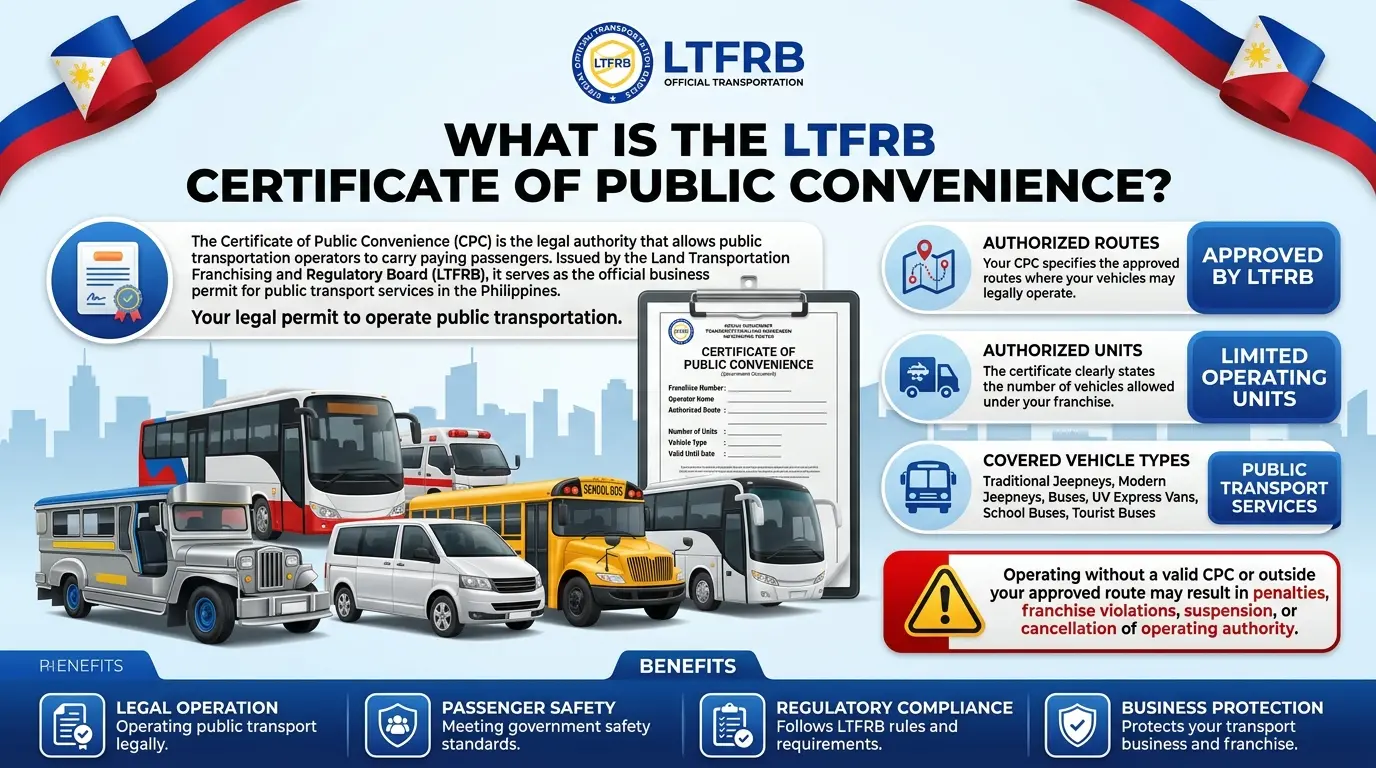
The Certificate of Public Convenience is your legal permit to operate public transport. The Land Transportation Franchising and Regulatory Board issues it. Without this certificate, you cannot legally carry paying passengers on Philippine roads.
Think of it as your business license for transport services. It proves the LTFRB reviewed your application, approved your route, and authorized your vehicles. The certificate shows you meet safety standards and follow government regulations.
The CPC covers specific vehicle types: traditional jeepneys, modern jeepneys, buses, UV Express vans, school buses, tourist buses, and similar vehicles for hire. Regular taxis and transport network vehicle services like Grab follow different franchise rules.
Your certificate lists important details. It shows your authorized route, the number of units you can operate, your business name, and the validity period. These details matter because operating outside your approved route or with extra units violates your franchise terms.
Why Do Transport Operators Need a Certificate of Public Convenience?
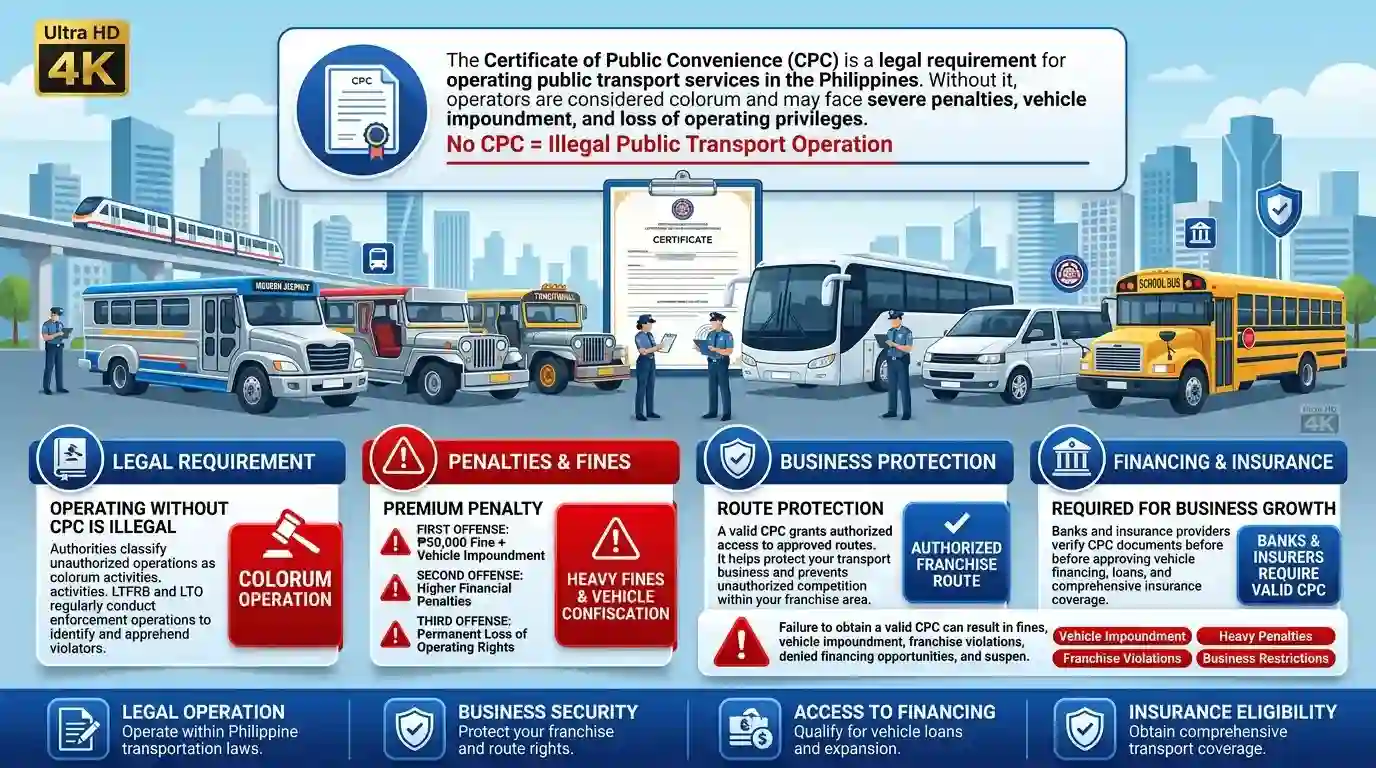
Operating without a CPC is illegal. The law treats it as colorum operation. Authorities can confiscate your vehicle, impose heavy fines, and file criminal charges against you.
The penalties hit hard. First offense brings a ₱50,000 fine and vehicle impoundment. Second offense doubles that amount. Third offense means permanent revocation of your right to operate public transport. Those aren’t just theoretical consequences—the LTFRB and LTO conduct regular operations to catch colorum vehicles.
Beyond avoiding penalties, the CPC protects your business. It gives you exclusive rights to your route. Other operators cannot legally enter your franchise area without their own approval. That protection helps you build a stable business.
Banks and insurance companies also require valid CPCs. Want to finance a new jeepney? The bank will ask for your franchise papers. Need comprehensive insurance? Companies verify your CPC before issuing policies. Without it, you’re locked out of legitimate business opportunities.
What Are the Different Types of CPC Applications?
The LTFRB handles five main application types. Each serves a different situation. Filing the wrong type delays your process and wastes your time.
New Application for Certificate of Public Convenience
This applies when you’re starting fresh. You’ve never operated public transport before. You don’t have an existing franchise. You want to enter a new route that isn’t currently served or needs more operators.
New applications face the strictest scrutiny. The LTFRB evaluates whether the route needs additional service. They check if existing operators already meet passenger demand. They review your financial capacity to sustain operations. Expect this process to take the longest.
Extension of Validity
Your CPC comes with a validity period, typically five years. Before it expires, file an extension. This isn’t automatic—you must submit documents and pay fees.
Start your extension application at least six months before expiration. Filing late creates gaps in your legal authority. Some operators miss the deadline and end up needing reinstatement instead, which costs more and takes longer.
Amendment of Certificate
Need to change your route? Adding more units to your fleet? Updating your business name after incorporation? These require amendments.
Route amendments trigger public hearings. The LTFRB wants to know if existing operators will be affected. Unit additions require proof you can maintain quality service with more vehicles. Name changes need supporting documents from DTI or SEC.
Dropping and Substitution
Vehicles age. Engines fail. Accidents happen. When you need to replace a franchised unit, you file for substitution. This lets you drop the old vehicle and add a new one without changing your total authorized units.
Substitution also applies when selling your franchise to another operator. The new owner files to drop your name and substitute theirs while keeping the same route and unit count.
Reinstatement
Your CPC expired and you didn’t file for extension in time. Now you need reinstatement. This brings your dead franchise back to life.
Reinstatement works only if your expiration wasn’t too long ago. Wait more than two years and the LTFRB may require you to file as a new applicant instead. The process includes penalties for late filing, so extension always beats reinstatement.
What Documents Do You Need for CPC Application?
Missing documents kill more applications than anything else. Before you even think about going to the LTFRB office, gather everything on this list.
Accomplished LTFRB Application Form
Download the form from the official LTFRB website or get it at any regional office. Fill out every field. Incomplete forms get rejected immediately.
Write clearly. Use black ink if filling by hand. Double-check your route description, vehicle details, and contact information. One wrong digit in your plate number delays everything.
Proof of Filipino Citizenship
The law requires transport operators to be Filipino citizens or corporations with at least 60% Filipino ownership. Bring your PSA-authenticated birth certificate. If you’re naturalized, bring your naturalization papers.
For corporations, submit your SEC registration showing Filipino ownership percentage. For cooperatives, bring your CDA certificate of registration.
Vehicle Documents
You need the original and photocopy of your Certificate of Registration and Official Receipt. Both must be current. Expired registration means automatic rejection.
The CR must show the vehicle is registered for public utility use. Private vehicle registration won’t work. If you’re buying a brand new unit, bring the dealer’s invoice and temporary OR.
Business Registration Documents
Sole proprietors need DTI business name registration. Corporations need SEC registration and articles of incorporation. Cooperatives need CDA registration. These prove you’re operating a legitimate business entity.
Your business name on the LTFRB application must exactly match your DTI or SEC registration. Even small differences cause problems.
Mayor’s Permit or Business Permit
Get this from the city or municipality where your business is registered. The permit must be current. Expired permits need renewal before you can proceed.
Some LTFRB offices accept mayor’s permits from your garage location instead of your business registration address. Check with your specific regional office.
BIR Certificate of Registration
This shows you’re registered as a taxpayer. It proves you’ll pay taxes on your transport income. The BIR issues this after you register your business.
Bring both your BIR Form 2303 (Certificate of Registration) and your current year’s Annual Registration Fee payment receipt.
Route and Garage Maps
Sketch your proposed route on a clear map. Mark your starting point, endpoint, and all major stops along the way. Include street names and landmarks.
For your garage map, show the exact location where you’ll park vehicles overnight. Include the lot size, address, and proof you own or lease the space. Lease agreements work if you’re renting garage space.
Affidavit of Financial Capacity
This sworn statement declares you have the money to operate. Banks statements help. Property titles work. Business income records support your claim.
The LTFRB wants assurance you won’t abandon operations after three months because you ran out of capital. Show you can sustain at least six months of operations.
Insurance Coverage
You need two types: passenger personal accident insurance and third-party liability coverage. Insurance companies issue certificates showing your coverage amounts and validity dates.
Current law requires minimum coverage amounts. Check the latest LTFRB circulars for exact figures as these change periodically.
Drug Test Results
Drivers need drug test certificates from DOH-accredited laboratories. These prove your drivers are drug-free. Results stay valid for six months, so time your testing accordingly.
Medical Certificates
LTO-accredited clinics issue these after examining your drivers. They certify physical and mental fitness to drive public utility vehicles.
Pro Tip: Make three photocopies of every document. One stays with LTFRB. One goes in your vehicle as a working copy. One stays in your files at home. Never submit originals unless specifically required—clerks sometimes lose documents.
How Do You Apply for a Certificate of Public Convenience Step by Step?
The process follows a specific sequence. Skip a step and you start over. Here’s exactly how it works.
Step 1: Prepare All Required Documents
Lay out every document from the list above. Check expiration dates. Make sure names match across all papers. Organize them in a folder with originals separated from copies.
Create a checklist and tick off each item as you verify it. This simple act catches missing documents before you waste a trip to the LTFRB office.
Step 2: Submit Application to LTFRB Regional Office
Go to the LTFRB regional office covering your proposed route. Metro Manila operators go to the LTFRB central office in Quezon City. Provincial operators visit regional offices.
Submit your documents at the receiving window. The clerk will review them on the spot. If something’s missing or incorrect, they’ll tell you immediately. Fix it and come back.
Some regions now accept online applications through the LTFRB portal. Check if your area offers this option—it saves time and travel costs.
Step 3: Pay Application Fees
After document acceptance, the clerk calculates your fees. Rates vary by vehicle type and number of units. Expect to pay for application processing, legal research, franchise verification, and publication fees.
Payment happens at the cashier window. They accept cash. Some offices take credit cards. Get your official receipt and guard it carefully—it’s your proof of payment.
Step 4: Publication in Newspaper
The law requires publishing your application in a newspaper of general circulation. This gives existing operators and the public a chance to oppose your franchise if they have valid objections.
The LTFRB provides the format for your publication. Take it to any newspaper they recognize. The paper publishes it once. You get a publisher’s affidavit and tear sheet as proof.
Submit these publication documents back to LTFRB. This step costs around ₱2,000 to ₱5,000 depending on the newspaper.
Step 5: Attend Public Hearing
LTFRB schedules a hearing date, typically 30 to 45 days after publication. They notify you by mail or text. Show up on time. Bring originals of all your documents.
The hearing examines your application. LTFRB officers ask questions about your route, your capacity, your vehicles. Existing operators can present opposition. You defend your application and answer objections.
If everything checks out and no valid opposition exists, the hearing officer recommends approval. Dress presentably and speak respectfully—first impressions matter.
Step 6: Vehicle and Garage Inspection
LTFRB inspectors visit your garage. They check if it matches your submitted map. They verify it provides adequate space for your vehicles. They look for safety and security features.
They also inspect each vehicle. Seatbelts must work. Tires meet tread depth requirements. Body condition passes standards. Fire extinguishers are present. Route signboards are readable.
Failed inspections mean fixing problems and requesting re-inspection. This delays your approval, so prepare vehicles properly before the scheduled inspection.
Step 7: Await Board Resolution
After successful hearing and inspection, your file goes to the LTFRB board for final decision. They issue a board resolution either approving or denying your application.
Approval means you get your CPC. Denial comes with stated reasons. You can address those reasons and re-apply, or appeal the decision through proper legal channels.
Step 8: Claim Your Certificate
Once approved, LTFRB notifies you to claim your Certificate of Public Convenience. Bring your official receipt and valid ID. They release the certificate and franchise plates.
Install the franchise plates on your vehicle immediately. Keep the certificate in the vehicle at all times. Authorities check these during road inspections.
How Much Does a CPC Application Cost?
Costs vary based on your vehicle type and number of units. Here’s a breakdown of typical fees for 2026.
| Fee Type | Amount | Notes |
|---|---|---|
| Application Filing Fee | ₱510 | Per application, regardless of units |
| Legal Research Fee | ₱10 | Per document submitted |
| Franchise Verification Fee | ₱40 | Per unit |
| Vehicle Inspection Fee | ₱500 – ₱1,000 | Depends on vehicle size |
| Garage Inspection Fee | ₱500 | One-time fee |
| Publication Fee | ₱2,000 – ₱5,000 | Paid directly to newspaper |
| CPC Issuance Fee | ₱1,500 | Upon approval |
A single-unit jeepney application typically runs ₱5,000 to ₱8,000 in total fees. Multiple units increase costs proportionally. Budget extra for unexpected expenses like additional document authentication or courier fees.
These are official fees. Anyone asking for “processing fees” or “facilitation fees” outside official channels is likely asking for a bribe. Report such incidents to LTFRB’s complaints desk.
How Long Does the CPC Application Process Take?
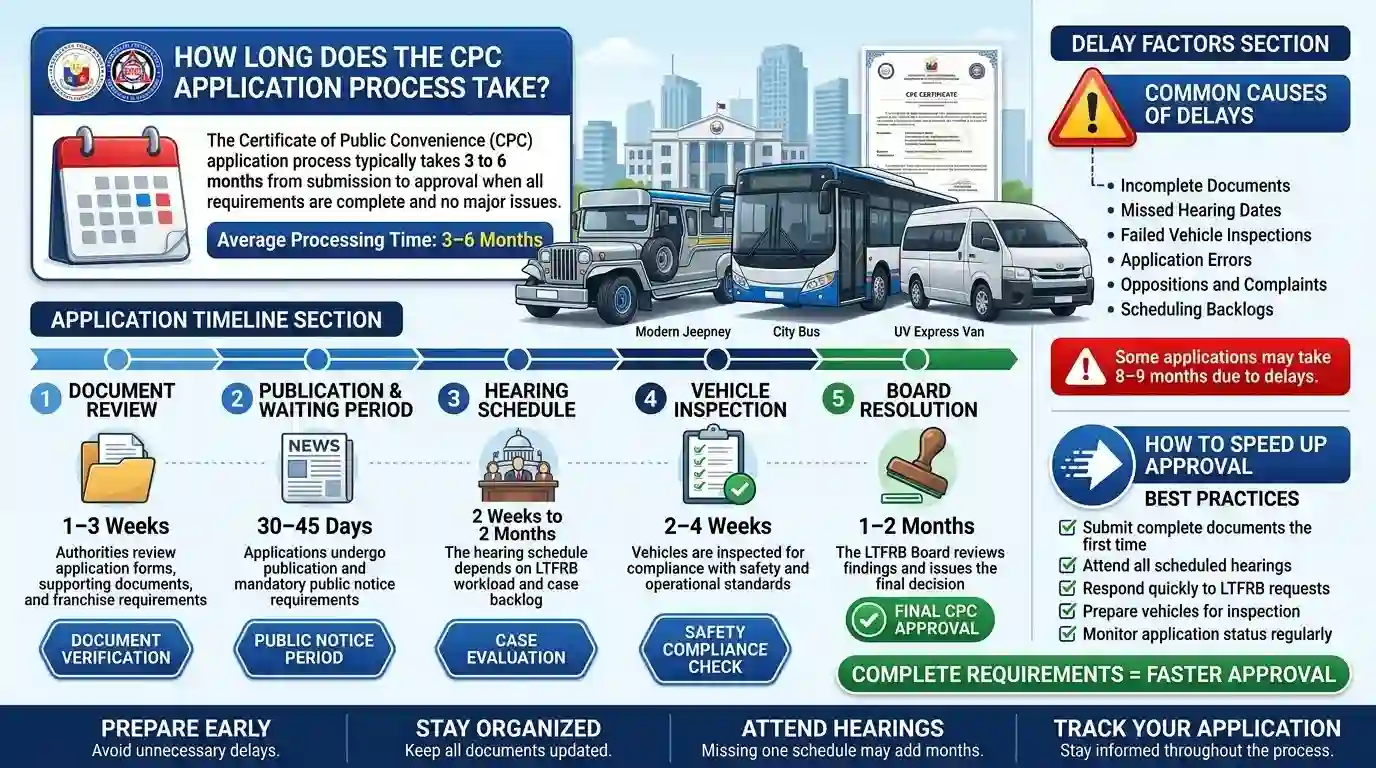
Expect three to six months from application to approval. That’s the realistic timeline when everything goes smoothly.
Document review takes one to three weeks. Publication and waiting period add 30 to 45 days. Hearing schedules depend on case backlog—sometimes within two weeks, sometimes two months out. Inspection scheduling adds another two to four weeks. Board resolution takes one to two months after successful hearing.
Delays happen when documents are incomplete, hearings get postponed, inspections fail, or oppositions arise. Some applications stretch to eight or nine months.
You can speed things up by submitting perfect documents the first time, attending all scheduled appointments promptly, and maintaining responsive communication with LTFRB staff. Missing one hearing date pushes you back months.
How Long Is a Certificate of Public Convenience Valid?
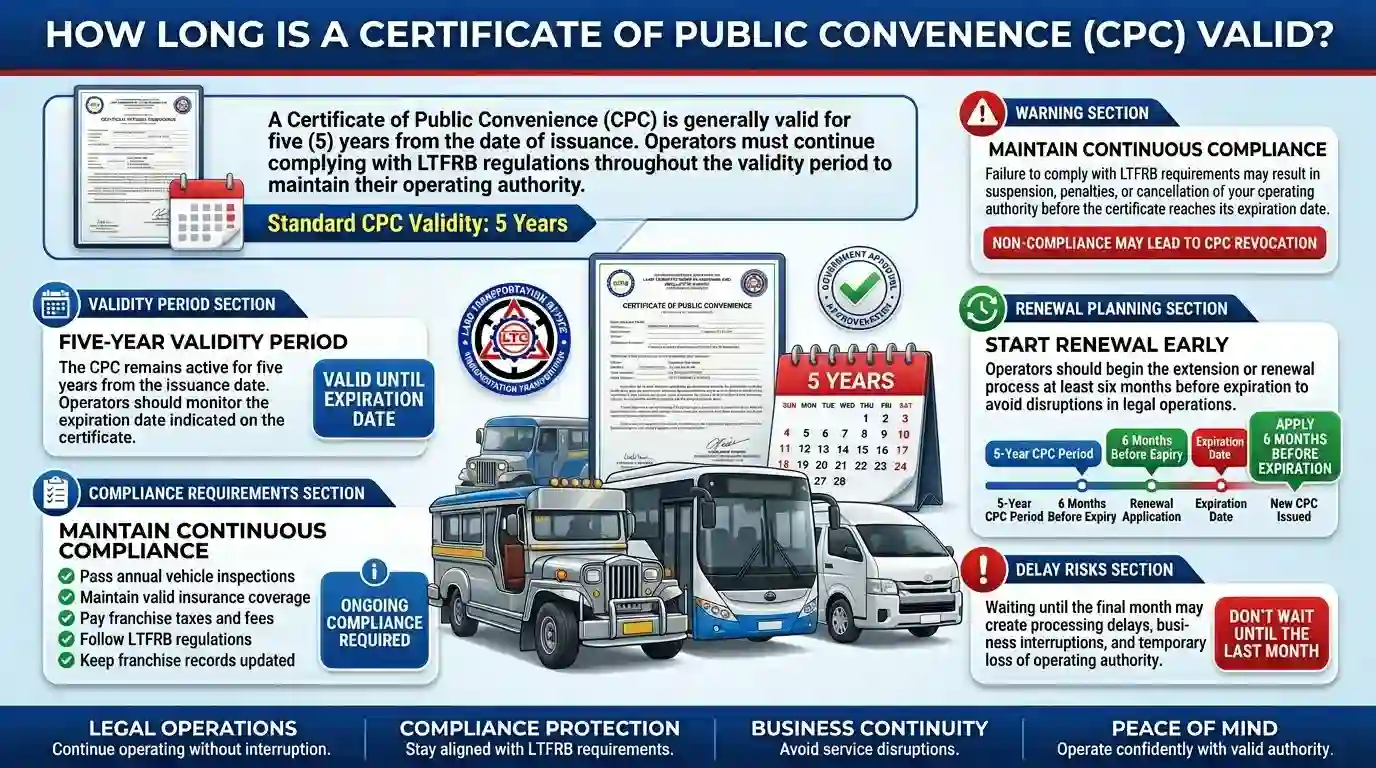
Standard CPCs carry a five-year validity period from the date of issuance. Your certificate shows the exact expiration date. Mark it on your calendar.
During these five years, you must maintain compliance with all LTFRB rules. Annual inspections are required. Keep your insurance current. Pay your franchise taxes on time. Violations can result in suspension or revocation before expiration.
Six months before expiration, start your extension application. Don’t wait until the last month. Processing takes time and late filing creates legal operation gaps.
What Legal Framework Governs the Certificate of Public Convenience?
The CPC system operates under Commonwealth Act No. 146, known as the Public Service Act. This 1936 law established the franchise requirement for public utilities including transport services.
Executive Order No. 202 created the LTFRB in 1987, transferring franchise authority from the old Board of Transportation to this new agency. The LTFRB operates under the Department of Transportation.
Republic Act No. 4136, the Land Transportation and Traffic Code, also applies. It sets vehicle standards and driver requirements. RA 11032, the Ease of Doing Business Act, introduced reforms to speed up processing.
Presidential Decree 1605 penalizes colorum operations. It sets the fines and penalties for operating without a valid franchise. DOTr Department Orders and LTFRB Memorandum Circulars provide specific implementing rules.
Understanding this legal framework helps you see why requirements exist and why the process follows certain steps. For those looking for more government services, the LTO Portal offers helpful information about vehicle registration and licensing procedures.
What Common Mistakes Delay CPC Applications?
First-time applicants make predictable errors. Avoid these and you’ll move faster than most.
Submitting Incomplete Documents
This tops the list. People show up missing one paper—maybe an expired mayor’s permit or an unsigned affidavit. The clerk rejects the application on the spot. You go home, fix it, and come back next week. That’s a month lost right there.
Incorrect Route Descriptions
Vague route descriptions create problems. “From Cubao to Antipolo” isn’t enough. LTFRB needs specific streets: “From Farmers Market Cubao via Aurora Boulevard, Marcos Highway, Sumulong Highway to Antipolo Town Center.” Include all turns and major intersections.
Mismatched Information Across Documents
Your DTI registration says “Juan dela Cruz Transport Services” but your LTFRB form says “J. dela Cruz Transport.” These must match exactly. Even spacing and punctuation matter. Mismatches raise red flags about document authenticity.
Skipping the Hearing
Some applicants treat the hearing as optional. It’s not. Miss it and your application gets archived. You’ll need to refile from scratch, pay new fees, and start over.
Inadequate Garage Space
You apply for ten units but your garage fits five. Inspectors measure. If your space doesn’t accommodate your requested units, they fail you. Right-size your application to your actual capacity.
Expired Insurance or Drug Tests
By the time your hearing arrives, your driver’s drug test expired. Or your insurance lapsed. Keep validity dates aligned with your expected approval timeline. Renew early if needed.
Failing to Oppose Oppositions
Another operator objects to your application at the hearing. You stay silent or respond weakly. The hearing officer takes their side. Prepare to defend your application with facts, data, and proof of public need for your service.
What Benefits Come With a Valid CPC?
Operating with a proper franchise opens doors beyond just legal compliance.
Legal Protection
Your CPC shields you from colorum penalties. No more worrying about checkpoints. No risk of vehicle impoundment. You operate with full legal authority.
Exclusive Route Rights
Your franchise gives you rights to your route. New applicants face higher scrutiny when routes already have adequate service. Your existing CPC provides competitive protection.
Access to Financing
Banks finance franchised operators. They won’t touch colorum vehicles. With a CPC, you can get loans for new units, garage improvements, or business expansion. Interest rates are lower because your business is legitimate.
Insurance Coverage
Comprehensive insurance requires a franchise. Without it, you’re limited to basic third-party liability at best. With a CPC, you get full coverage protecting your investment and your passengers.
Government Programs
The government’s Public Utility Vehicle Modernization Program offers subsidies and financing support. Only franchised operators qualify. Your CPC is your ticket to these benefits.
Business Credibility
Passengers trust franchised vehicles more. Companies prefer contracting with legitimate operators for employee transport. Schools want franchised buses. Your CPC builds credibility that attracts better opportunities.
Transferable Value
When you eventually sell your transport business, the franchise adds significant value. Buyers pay premium prices for operating franchises over just purchasing vehicles.
Can You Transfer Your CPC to Another Person?
Yes, but not directly. CPCs don’t transfer like property titles. The process involves selling the entire franchised operation and filing for substitution of operator.
The buyer must meet all CPC requirements. They submit documents proving Filipino citizenship, financial capacity, and business registration. They file a substitution application with LTFRB.
LTFRB evaluates the new operator using the same standards as new applications. If approved, they drop your name and substitute the buyer’s information while maintaining the same route and unit count.
Some operators sell franchises at high prices, especially for lucrative routes. The franchise itself has market value separate from the vehicle. Prices depend on route profitability and remaining validity period.
What Happens If You Operate Without a CPC?
Operating without a franchise is called “colorum” operation. The term comes from Latin legal terminology and has been part of Philippine transport law for decades.
Penalties are severe. First offense brings a ₱50,000 fine plus immediate vehicle impoundment. You’ll pay impounding fees, storage fees, and towing charges on top of the fine. These costs often exceed ₱70,000.
Second offense doubles the fine to ₱100,000. Vehicle impoundment lasts longer. Criminal charges may be filed against the operator and driver.
Third offense results in permanent disqualification from operating public transport. Your vehicle gets impounded indefinitely. You face criminal prosecution. The penalties can include imprisonment.
Beyond legal penalties, colorum operators face practical problems. Accidents involving colorum vehicles create insurance nightmares. Passengers can’t claim compensation. You bear full liability personally. One serious accident can bankrupt you.
Banks won’t finance colorum operations. Insurance companies won’t cover you. You operate in constant fear of checkpoints. Passengers increasingly avoid non-franchised vehicles. The risks far outweigh any perceived savings from skipping the franchise process.