LTO Transfer of Ownership: Complete Guide to Transferring Vehicle Ownership in the Philippines
Buying a car or motorcycle in the Philippines comes with paperwork. One of the most important steps is transferring the title to your name through the Land Transportation Office (LTO). According to the Department of Transportation, over 300,000 vehicles change ownership every year in the Philippines, making the transfer process a common concern for buyers nationwide. This guide walks you through everything you need to know about LTO transfer of ownership, from requirements to fees, penalties, and the actual process for both cars and motorcycles.
What Is LTO Transfer of Ownership?
LTO transfer of ownership is the legal process of changing a vehicle’s registered owner from the seller to the buyer. This process updates the vehicle’s Certificate of Registration (CR) and Official Receipt (OR) with the new owner’s name, making you the legal owner of the vehicle. Without completing this transfer, you cannot legally operate the vehicle under your name, and any violations or issues tied to the vehicle remain connected to the previous owner.
Why Do You Need to Transfer Vehicle Ownership?
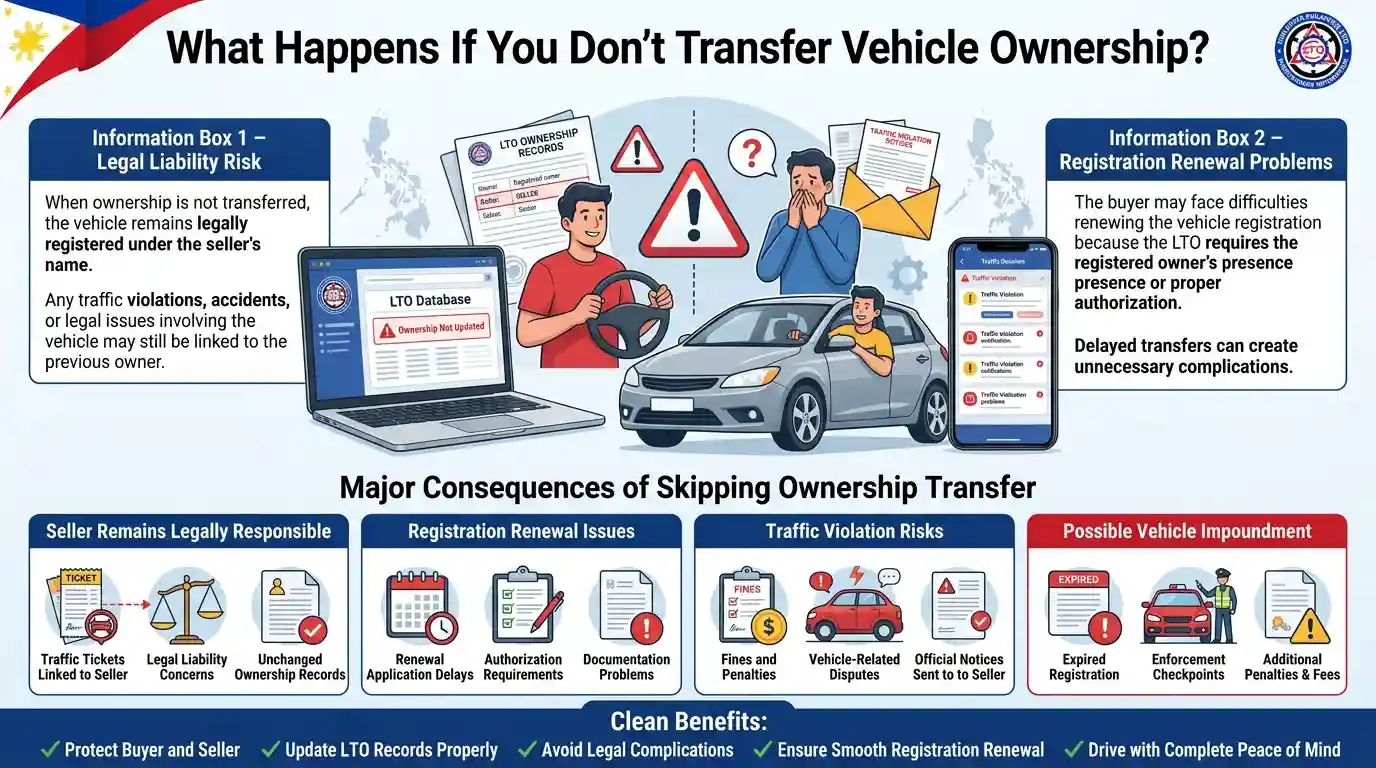
Transferring ownership protects both you and the seller. If you skip this step, the previous owner remains liable for traffic violations, accidents, and legal issues involving the vehicle. You also cannot renew the registration or sell the vehicle legally without the transfer. More importantly, driving an unregistered vehicle under your name can result in fines and impoundment.
The transfer also ensures that insurance claims, theft reports, and other legal matters are processed under the correct owner. Many buyers delay this process to save time or money, but that creates bigger problems later.
What Are the LTO Requirements for Transfer of Ownership?
Before heading to the LTO office, gather all the necessary documents. Missing even one can delay the entire process by days or weeks. Here are the required documents:
- Original Certificate of Registration (CR) – The current registration under the seller’s name.
- Original Official Receipt (OR) – Proof that the seller paid the most recent registration fees.
- Deed of Absolute Sale – A notarized document showing the sale between buyer and seller. Both parties must sign this.
- Valid ID of Buyer and Seller – Government-issued IDs such as driver’s license, passport, or UMID.
- Certificate of Emission Compliance – Proof that the vehicle passed emissions testing. This must be obtained from accredited emission centers.
- Third-Party Liability (TPL) Insurance Certificate of Cover (COC) – Insurance coverage in the name of the new owner. You can purchase this from any accredited insurance provider.
- PNP-HPG Clearance – A clearance from the Philippine National Police-Highway Patrol Group to verify the vehicle is not involved in any crime. This step is sometimes waived for newer vehicles.
- Release of Chattel Mortgage – If the vehicle was financed through a loan, you need proof that the loan has been fully paid and the mortgage has been released. This must be stamped by the Registry of Deeds.
Make photocopies of all documents. The LTO will keep the originals and may require extra copies for their records.
What Are the LTO Requirements for Transfer of Ownership for Motorcycles?
The requirements for transferring ownership of a motorcycle are almost identical to those for cars. You need the same set of documents, including the CR, OR, Deed of Absolute Sale, valid IDs, emission test certificate, TPL insurance, and PNP clearance. Motorcycles must also pass the emission test, even though some riders assume smaller engines are exempt. They are not.
One difference is that motorcycle transfers tend to process faster because the queues at LTO offices are shorter for two-wheeled vehicles. Some LTO branches have separate counters for motorcycles, which speeds things up.
How Much Is the LTO Transfer of Ownership Fee?
The total cost of transferring vehicle ownership depends on the type of vehicle and where you complete the process. Below is a breakdown of typical fees:
| Fee Type | Estimated Cost |
|---|---|
| Transfer Fee (Cars) | ₱250 – ₱350 |
| Transfer Fee (Motorcycles) | ₱150 – ₱250 |
| Notary Fee (Deed of Sale) | ₱100 – ₱300 |
| Emission Testing | ₱500 – ₱800 |
| TPL Insurance | ₱400 – ₱800 |
| PNP-HPG Clearance | ₱100 – ₱200 |
| Registry of Deeds (if applicable) | ₱800 – ₱1,200 |
Overall, expect to spend between ₱2,000 and ₱4,000 for the entire transfer process. If you hire a fixer or facilitator, add another ₱1,500 to ₱3,000, though this is not recommended since the process is straightforward if you follow the steps.
What Is the LTO Transfer of Ownership Motorcycle Fee?
The transfer fee for motorcycles is lower than for cars. At the LTO, you will pay around ₱150 to ₱250 for the official transfer. Add in the notary fee, emission test, TPL insurance, and clearance, and the total comes to roughly ₱1,500 to ₱2,500. Motorcycle owners save a bit compared to car owners, but the process is just as strict.
How to Transfer LTO Ownership: Step-by-Step Process
Here is the actual process for transferring vehicle ownership at the LTO. Follow these steps carefully to avoid delays.
Step 1: Prepare All Required Documents
Gather all the documents listed earlier. Check that the Deed of Absolute Sale is notarized and that all names are spelled correctly. Even a small typo can cause problems. Make sure the TPL insurance is in your name, not the seller’s.
Step 2: Get the Vehicle Cleared (If Financed)
If the vehicle was bought through financing, you need to cancel the chattel mortgage. Go to the Registry of Deeds where the mortgage was registered. Bring the Release of Chattel Mortgage document from the bank or financing company, along with photocopies of all your documents. Pay the processing fee, which is usually around ₱800 to ₱1,200. This step can take a full day, so plan accordingly.
Step 3: Visit the LTO Branch Where the Vehicle Is Registered
Head to the LTO office where the vehicle was originally registered. If that branch is too far, you can go to any LTO office, but you will need to request a transfer of records, which adds extra time. At the LTO, proceed to the records section and present your documents. The staff will verify the vehicle’s history and check for any violations or unpaid fees.
Step 4: Pay the Transfer Fees
Once your documents are verified, proceed to the cashier to pay the transfer fees. Keep the receipt. This is your proof of payment, and you will need it for the next steps.
Step 5: Submit Documents for Processing
Return to the records section and submit all your documents along with the payment receipt. The LTO will process your application and generate a new Certificate of Registration and Official Receipt in your name. This can take anywhere from a few hours to a few days, depending on how busy the office is.
Step 6: Receive Your New CR and OR
Once processing is complete, you will receive your new CR and OR. Double-check all the information before leaving the office. Make sure your name, address, and vehicle details are correct. If there are errors, report them immediately.
For those who went to a different LTO branch, you may need to wait for the documents to be mailed to the original branch and then mailed back to you. This can take two to four weeks.
What Happens If You Don’t Transfer Ownership?
Skipping the transfer has consequences. The vehicle remains under the seller’s name, which means they are still legally responsible for it. If you get into an accident or commit a traffic violation, the seller can be held liable. Most sellers will not hand over the vehicle until the transfer is complete for this exact reason.
You also cannot renew the registration. When the annual renewal is due, the LTO will require the registered owner to appear or provide authorization. Without the transfer, you cannot complete this process. Driving with an expired registration results in fines and possible impoundment.
What Is the LTO Transfer of Ownership Penalty?
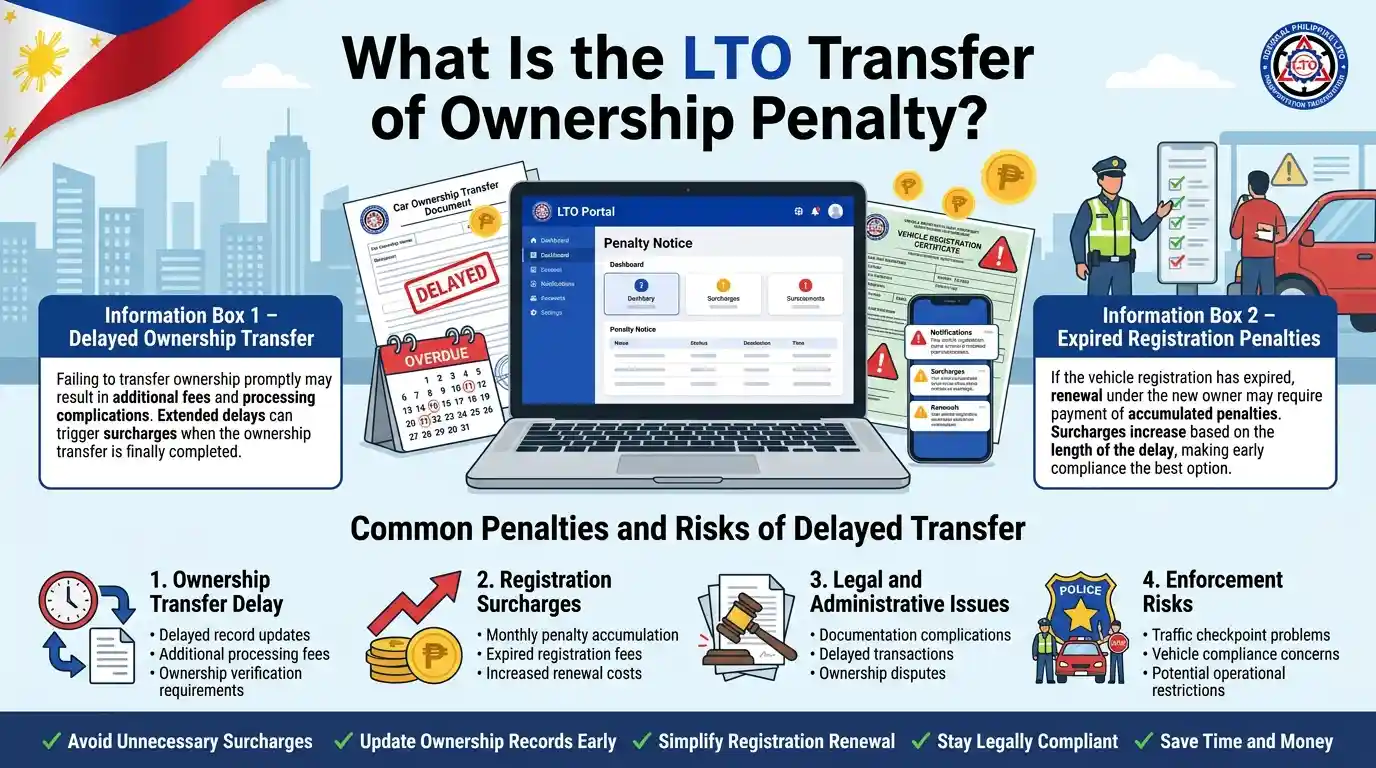
If you fail to transfer ownership within a specific period, penalties apply. The LTO requires the transfer to be completed within a “reasonable time,” though this is not strictly defined. Delays of more than a year often result in surcharges when you finally process the transfer.
Late registration also carries penalties. If the vehicle’s registration has expired and you attempt to renew it under the new owner, you will pay a surcharge based on how many months it has been expired. The penalty starts at ₱100 per month and can accumulate quickly.
Some LTO offices are lenient if you can explain the delay, but do not count on it. Complete the transfer as soon as possible after buying the vehicle.
Can You Transfer Ownership Online?
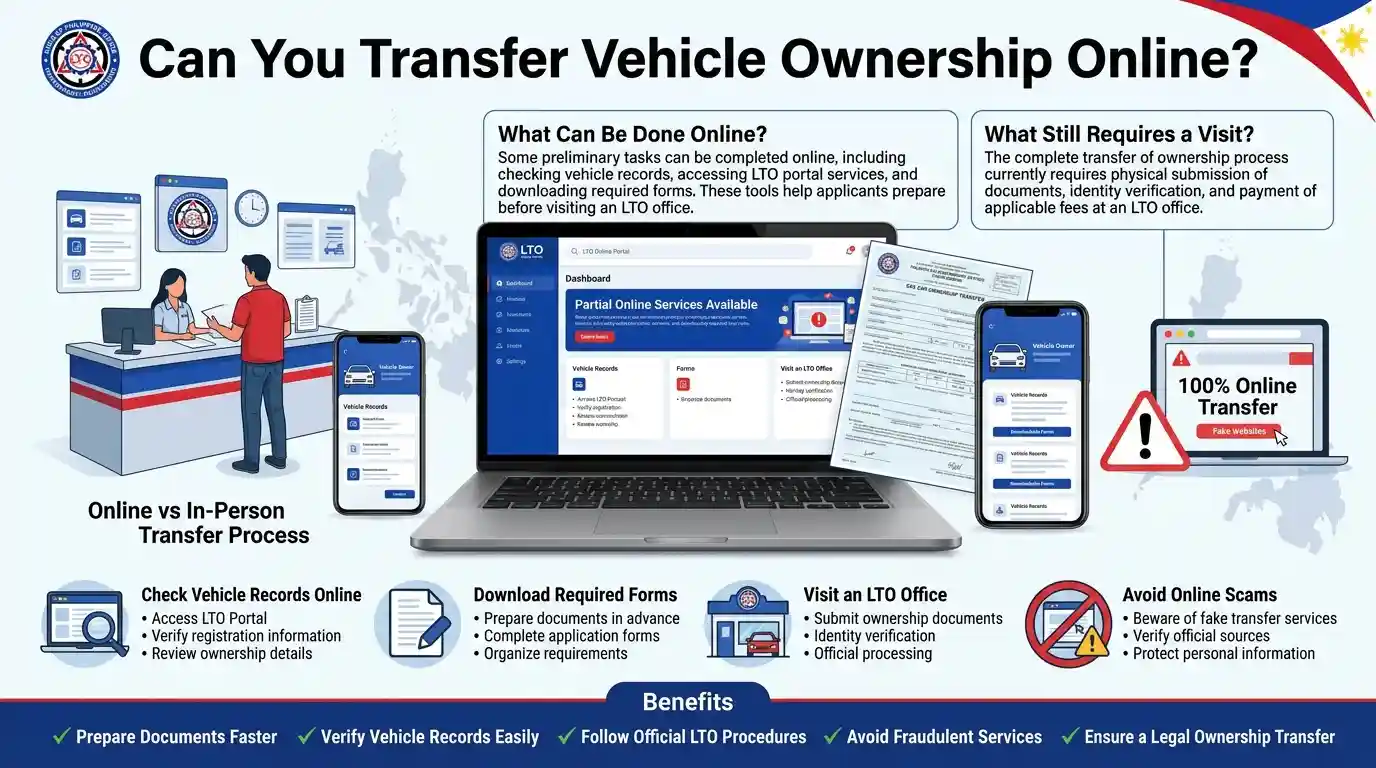
Currently, the full LTO transfer of ownership process cannot be completed online. You must visit an LTO office in person to submit documents and pay fees. However, some preliminary steps can be done online through the LTO Portal, such as checking vehicle records and downloading forms.
There have been discussions about digitizing more LTO services, but as of now, the transfer process requires physical presence. Be cautious of third-party websites claiming to offer full online transfers. These are often scams or services that still require you to visit the LTO eventually.
Tips for a Smooth LTO Transfer Process
Here are a few practical tips to make the transfer process easier:
- Go to the LTO office early in the morning. Lines build up quickly by mid-morning, especially on weekdays.
- Bring extra photocopies of all documents. The LTO may ask for additional copies.
- Verify that the seller has no pending violations before you buy the vehicle. Unpaid tickets can delay the transfer.
- Check that the VIN (Vehicle Identification Number) on the documents matches the one on the vehicle.
- If the seller cannot accompany you, get a notarized Special Power of Attorney (SPA) authorizing you to process the transfer on their behalf.
Pro Tip: Avoid fixers at the LTO office. The process is straightforward, and paying a fixer only adds unnecessary cost. Follow the steps yourself and save the money.