What Is the Hour of Code? A Complete Guide to Metro Manila Number Coding Hours
The “hour of code” refers to specific time blocks when vehicles with certain license plate endings cannot travel on public roads in Metro Manila. This is part of the Unified Vehicular Volume Reduction Program, better known as the number coding scheme. The Metropolitan Manila Development Authority (MMDA) implemented this to cut traffic congestion during peak hours.
Around 4.3 million registered vehicles operate in Metro Manila as of 2024, according to the Land Transportation Office. That number keeps climbing. Without traffic management rules, the roads would gridlock completely. The coding system rotates restrictions across weekdays, giving each plate number one day off the road.
This guide covers everything about coding hours in Metro Manila: standard MMDA schedules, city-specific rules in Makati and Pasig, window hours when you can drive freely, and how to avoid violations. You will also learn which vehicles are exempt and what penalties apply if you break the rules.
What Are the Standard Number Coding Hours in Metro Manila?
Quick Answer: The standard MMDA coding hours run from 7:00 AM to 10:00 AM and 5:00 PM to 8:00 PM on weekdays. These are the morning and evening rush periods when coded vehicles must stay off major roads across Metro Manila.
The MMDA enforces this schedule Monday through Friday. Weekends have no coding. National holidays also suspend the scheme unless announced otherwise. The restricted hours target peak traffic times when commuters head to work and return home.
During coding hours, vehicles with specific plate endings cannot use roads covered by the program. That means if your plate ends in 1 or 2, you cannot drive during those windows on Mondays. Tuesday restricts plates ending in 3 or 4, and so on.
But there is a gap. Between 10:01 AM and 4:59 PM, all vehicles can travel freely. This is the window hour period when coding does not apply.
How the Coding Schedule Works by Day
| Day | Restricted Plate Endings | Coding Hours |
|---|---|---|
| Monday | 1, 2 | 7:00 AM – 10:00 AM, 5:00 PM – 8:00 PM |
| Tuesday | 3, 4 | 7:00 AM – 10:00 AM, 5:00 PM – 8:00 PM |
| Wednesday | 5, 6 | 7:00 AM – 10:00 AM, 5:00 PM – 8:00 PM |
| Thursday | 7, 8 | 7:00 AM – 10:00 AM, 5:00 PM – 8:00 PM |
| Friday | 9, 0 | 7:00 AM – 10:00 AM, 5:00 PM – 8:00 PM |
| Saturday | None | No coding |
| Sunday | None | No coding |
Check your license plate’s last digit. That tells you which day you cannot drive during rush hours. A plate ending in 7 means Thursday is your coding day. Simple as that.
What Are Window Hours for Coding in Manila?
Quick Answer: Window hours are the time slots between morning and evening coding periods when all vehicles can travel freely. For most Metro Manila cities, this is 10:01 AM to 4:59 PM on weekdays.
Window hours give coded vehicles a legal way to move around during the day. If your car is coded on Wednesday but you need to run errands at noon, you are fine. The restriction only applies during the two rush hour blocks.
This break exists because midday traffic is lighter. Fewer people commute between 10 AM and 5 PM, so the roads can handle full vehicle volume without major congestion. The MMDA designed the system this way to balance traffic control with practical mobility needs.
Some cities modify these hours. Makati, for example, has stricter rules with a shorter window. Always check local ordinances if you drive through multiple cities in one trip.
Window Hours by City
- MMDA standard: 10:01 AM to 4:59 PM
- Makati: 10:00 AM to 3:00 PM (shorter window)
- Pasig: 10:01 AM to 4:59 PM
- Quezon City: 10:01 AM to 4:59 PM
- Pasay: 10:01 AM to 4:59 PM
- Taguig: 10:01 AM to 4:59 PM
Makati stands out because it runs coding from 7:00 AM to 7:00 PM with minimal break time. That is one reason many drivers avoid passing through Makati on their coding day unless absolutely necessary.
How Do Coding Hours Differ Across Metro Manila Cities?
Quick Answer: While the MMDA sets standard coding hours, cities like Makati, San Juan, and Muntinlupa enforce their own stricter schedules. Some extend coding until 7:00 PM or limit window hours to manage local traffic.
Metro Manila has 17 local government units. Each one can pass ordinances that modify the basic MMDA rules. This creates inconsistencies. A route that crosses three cities might subject you to three different coding policies on the same trip.
Makati enforces the longest coding hours: 7:00 AM to 7:00 PM. San Juan runs a similar schedule but with a slightly longer window from 10:00 AM to 3:00 PM. Muntinlupa only applies coding on specific major roads like Alabang-Zapote Road and the National Road through Ayala Alabang.
Then there are cities like Marikina, which does not enforce number coding on local roads at all. If you stay within Marikina city limits, coding does not apply. But the moment you enter a national highway that crosses into another city, you fall under MMDA jurisdiction again.
Makati Coding Hours
Makati has the toughest coding policy in Metro Manila. The city enforces a 12-hour restriction from 7:00 AM to 7:00 PM. There is a window hour from 10:00 AM to 3:00 PM, but it is much shorter than the standard MMDA break.
This applies to all major roads in Makati, including Ayala Avenue, EDSA within Makati boundaries, Buendia Avenue, and Gil Puyat. Even side streets are covered if they connect to these main arteries. Makati enforces this strictly with traffic enforcers stationed at key intersections.
Why so strict? Makati hosts the country’s largest business district. Thousands of offices, banks, and corporate headquarters operate here. Without extended coding, traffic would collapse during business hours.
Quezon City Coding Hours
Quezon City follows the standard MMDA schedule: 7:00 AM to 10:00 AM and 5:00 PM to 8:00 PM. Window hours run from 10:01 AM to 4:59 PM. This applies to major roads like Commonwealth Avenue, Quezon Avenue, and EDSA within QC limits.
But QC has many barangay roads where coding is loosely enforced. If you know the alternate routes through residential areas, you can sometimes avoid the main thoroughfares during coding hours. Just do not get caught on a major road.
Taguig Coding Hours
Taguig enforces coding on national roads like C-5, Bayani Road, and the East Service Road. But Bonifacio Global City (BGC) is exempt. You can drive through BGC on your coding day without penalty. The exemption exists because BGC manages its own traffic separately from the rest of Taguig.
Outside BGC, Taguig follows standard MMDA hours: 7:00 AM to 10:00 AM and 5:00 PM to 8:00 PM. Window hours are 10:01 AM to 4:59 PM.
Pasig Coding Hours
Pasig also sticks to MMDA hours: 7:00 AM to 10:00 AM and 5:00 PM to 8:00 PM. The coding window is 10:01 AM to 4:59 PM. Major roads like Ortigas Avenue, C-5, and Julia Vargas Avenue enforce this strictly.
Pasig has many business districts — Ortigas Center, Kapitolyo, and Rosario — so traffic enforcers are active. Expect checkpoints during peak hours near major intersections.
Pasay Coding Hours
Pasay applies coding on EDSA, Taft Avenue, and Roxas Boulevard. The schedule matches MMDA standards: 7:00 AM to 10:00 AM and 5:00 PM to 8:00 PM. Window hours are 10:01 AM to 4:59 PM.
Pasay is a major gateway to NAIA and the Entertainment City area. If you are heading to the airport on your coding day, plan around the restricted hours or take alternative transport.
Parañaque Coding Hours
Parañaque enforces coding on major roads like Sucat Road, Dr. A. Santos Avenue, and the Coastal Road. The schedule is 7:00 AM to 10:00 AM and 5:00 PM to 8:00 PM. Window hours are 10:01 AM to 4:59 PM.
Las Piñas Coding Hours
Las Piñas follows the same MMDA schedule. Coding applies on Alabang-Zapote Road and the Coastal Road. Hours are 7:00 AM to 10:00 AM and 5:00 PM to 8:00 PM, with a window from 10:01 AM to 4:59 PM.
Muntinlupa Coding Hours
Muntinlupa only enforces coding on specific roads: Alabang-Zapote Road, East Service Road, and the National Road through Ayala Alabang. Most residential streets are exempt. If you stay off these main roads, coding does not apply.
Cavite Coding Hours
Cavite is not part of Metro Manila, but some cities near the border enforce their own coding schemes. General Trias, for example, applies coding on Governors Drive. Bacoor has coding on certain roads during peak hours. Check local ordinances if you regularly drive between Metro Manila and Cavite.
Valenzuela Coding Hours
Valenzuela applies standard MMDA coding on major roads like MacArthur Highway and the North Luzon Expressway (NLEX) exit points. Hours are 7:00 AM to 10:00 AM and 5:00 PM to 8:00 PM. Window hours are 10:01 AM to 4:59 PM.
Who Is Exempt from the Number Coding Scheme?
Quick Answer: Government vehicles, medical emergency vehicles, public utility vehicles, electric vehicles under the EVIDA Law, and vehicles with special coding exemption permits are not subject to the number coding scheme in Metro Manila.
Exemptions exist for essential services and vehicles that contribute to public welfare. Ambulances cannot wait for coding hours. Fire trucks need 24/7 road access. Public buses and jeepneys carry dozens of passengers, so restricting them would worsen congestion instead of easing it.
Electric vehicles and hybrid cars with valid certification from the Department of Energy also get a pass. This is part of the Electric Vehicle Industry Development Act (EVIDA), which encourages adoption of cleaner transportation. If you own an EV, you can drive any day without worrying about your plate number.
Some private vehicles can apply for coding exemption permits through the local government. These are granted on a case-by-case basis for specific reasons like medical necessity or business operations that require 24/7 mobility. The process involves submitting documents and paying a fee. Approval is not guaranteed.
Full List of Exempt Vehicles
- Government-owned vehicles
- Ambulances and medical emergency vehicles
- Fire trucks
- Police and military vehicles on official duty
- Public utility buses
- Public utility jeepneys
- School buses with valid franchises
- Electric vehicles (EVs) with DOE certification
- Hybrid vehicles with DOE certification
- Vehicles with special coding exemption permits
- Diplomatic vehicles with proper plates
- Hearses and funeral vehicles
Taxis and ride-hailing vehicles (Grab, Uber) are NOT automatically exempt. They follow the same coding rules unless they have a special permit. Some taxi operators apply for exemptions, but most do not. Check with your driver if you are booking during coding hours.
How to Apply for a Coding Exemption Permit
Each city has its own process. In general, you need to submit a letter of request explaining why you need the exemption. Attach supporting documents like medical certificates, business permits, or proof of employment that requires irregular hours.
The local traffic management office reviews applications. Fees range from ₱500 to ₱2,000 depending on the city. Approval can take two to four weeks. Some cities require annual renewal.
Not all requests are granted. The exemption is meant for genuine need, not convenience. If you simply prefer not to deal with coding, your application will likely be denied.
What Happens If You Violate Number Coding?
Quick Answer: Violating the number coding scheme results in a ₱1,000 fine and a citation ticket from the MMDA or local traffic enforcers. Repeat violations within a month can lead to higher penalties and possible license suspension.
Enforcers can flag your vehicle at checkpoints or through mobile patrols. Once caught, you receive a traffic violation receipt. You must settle the fine within a set period, usually 15 days. Failing to pay on time adds surcharges and can result in an alarm on your vehicle registration when you renew through the LTO Portal.
If you accumulate multiple coding violations, the LTO may require you to attend a driver retraining seminar before clearing your record. In extreme cases, your license can be suspended. That is rare, but it does happen when violations pile up with other infractions like reckless driving or expired registration.
How to Pay a Coding Violation Fine
You can settle fines at MMDA payment centers or authorized banks. Bring your traffic violation receipt and a valid ID. Some cities also accept online payments through their official portals.
If you lost your violation receipt, visit the MMDA office or the traffic management office of the city where you were apprehended. They can retrieve your record using your license plate number. Bring proof of vehicle ownership and a government-issued ID.
Pay promptly. Ignoring fines leads to bigger problems when you renew your vehicle registration. The system flags unpaid violations, and you cannot complete the renewal until everything is settled.
How to Check If There Is Coding Today in Metro Manila
Quick Answer: Check the MMDA official website or social media pages for daily announcements. Coding is automatically suspended on weekends, national holidays, and special non-working days unless stated otherwise.
The MMDA posts updates on its Facebook and Twitter accounts every morning. If there is a holiday or suspension, they announce it by 6:00 AM. News sites like Rappler and ABS-CBN also publish daily traffic advisories that include coding status.
You can also visit the lto violation page for updates on window coding hours and any changes to the schedule. That page consolidates information from MMDA and local government announcements.
Another option is to call the MMDA hotline at 136. They provide real-time traffic updates and can confirm whether coding is in effect for the day. The line is open 24/7.
MMDA Social Media Channels
- Facebook: MMDA Official
- Twitter: @MMDA
- Website: mmda.gov.ph
Set up notifications for these accounts if you drive daily. That way, you get instant alerts about suspensions or changes to the coding schedule.
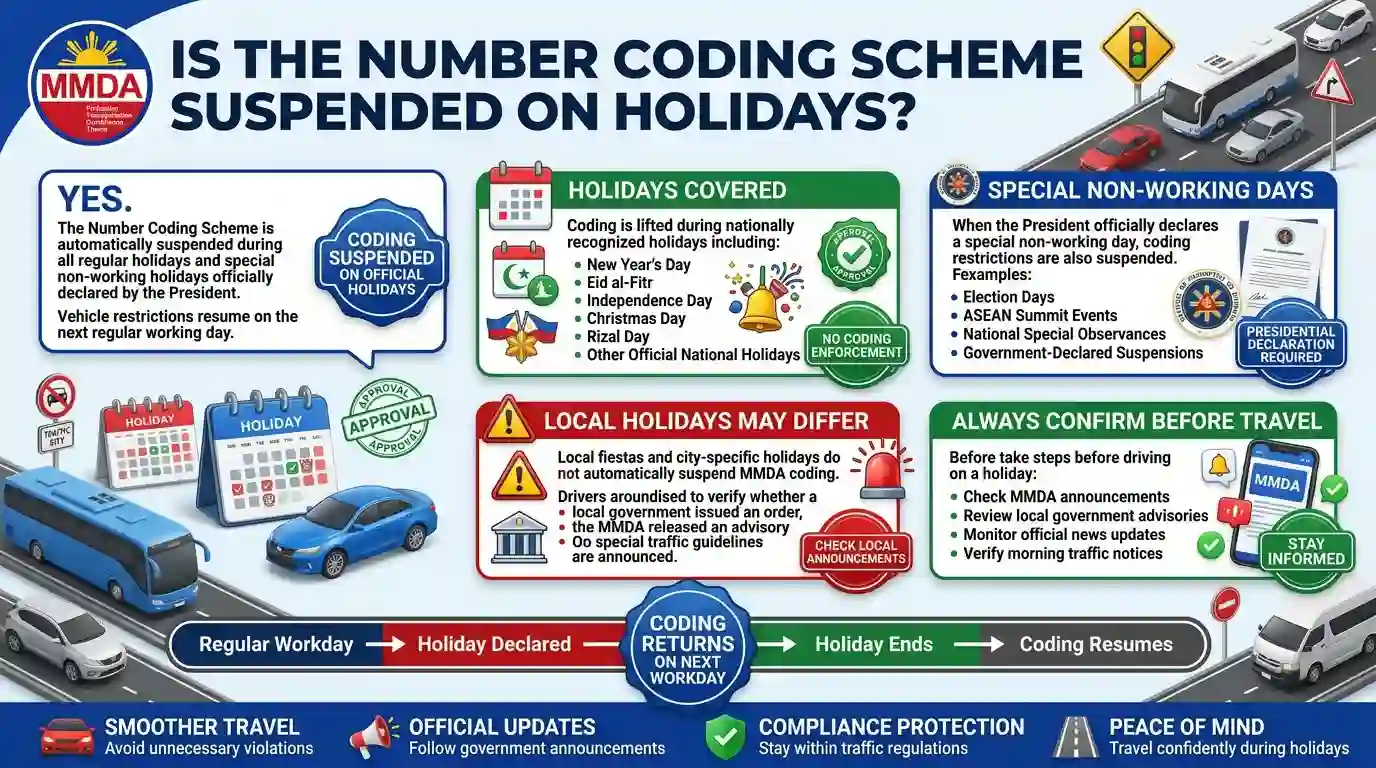
Is the Number Coding Scheme Suspended on Holidays?
Quick Answer: Yes, the number coding scheme is automatically suspended on all regular holidays and special non-working holidays declared by the President. Coding resumes on the next regular workday.
This includes major holidays like New Year, Eid al-Fitr, Independence Day, Christmas, and Rizal Day. When the President declares a special non-working day — like during elections or ASEAN summits — coding is also lifted.
But local holidays do not always count. If a city celebrates a local fiesta, that does not suspend MMDA coding unless the city government issues a separate order. Always check official announcements on the morning of any holiday to confirm.
Does Coding Apply on EDSA?
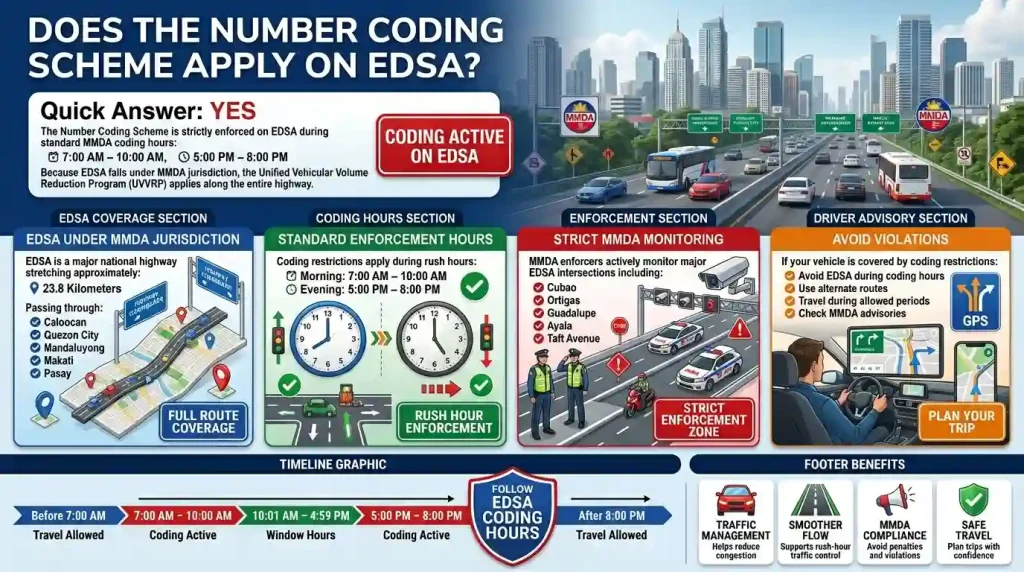
Quick Answer: Yes, the number coding scheme applies on EDSA during the standard hours of 7:00 AM to 10:00 AM and 5:00 PM to 8:00 PM. EDSA is a national road under MMDA jurisdiction, so the unified scheme is strictly enforced.
EDSA stretches 23.8 kilometers from Caloocan to Pasay, passing through multiple cities. Coding is active along the entire length during rush hours. MMDA deploys enforcers at major intersections like Cubao, Ortigas, and Ayala to catch violators.
Because EDSA is a critical artery, enforcement here is stricter than on smaller roads. Avoid using EDSA on your coding day unless you travel during window hours.
What Time Is Coding in Makati Specifically?
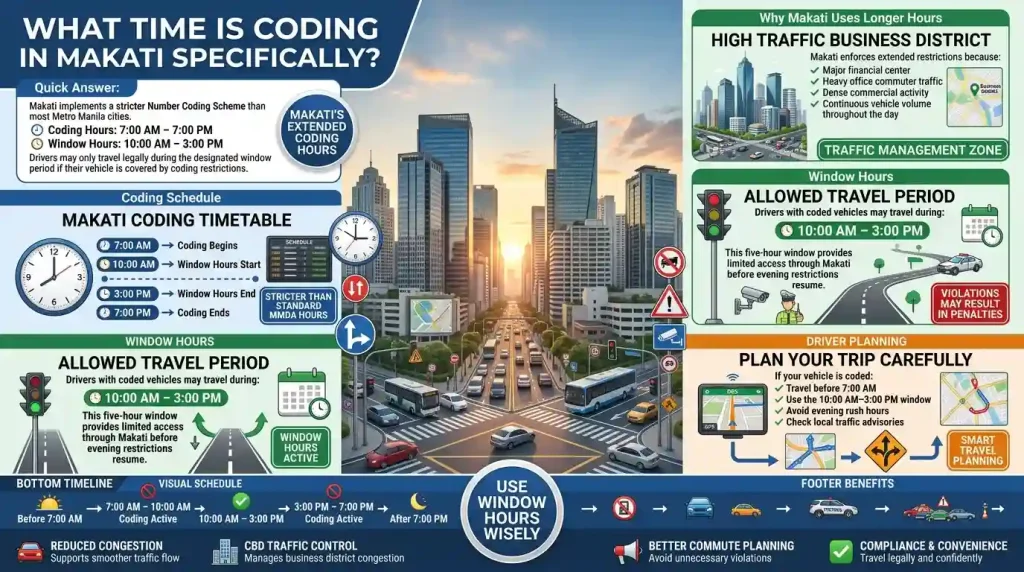
Quick Answer: Makati enforces number coding from 7:00 AM to 7:00 PM with a short window from 10:00 AM to 3:00 PM. This is stricter than the standard MMDA schedule used by other Metro Manila cities.
Makati extends coding hours because of its dense commercial activity. The central business district generates massive traffic throughout the day. By keeping restrictions active until 7:00 PM, the city tries to maintain flow during the evening commute.
The shorter window means you have less time to drive legally if your vehicle is coded. Plan trips through Makati carefully. If you need to cross the city on your coding day, do it between 10:00 AM and 3:00 PM.
Are There Coding Hours in Alabang?
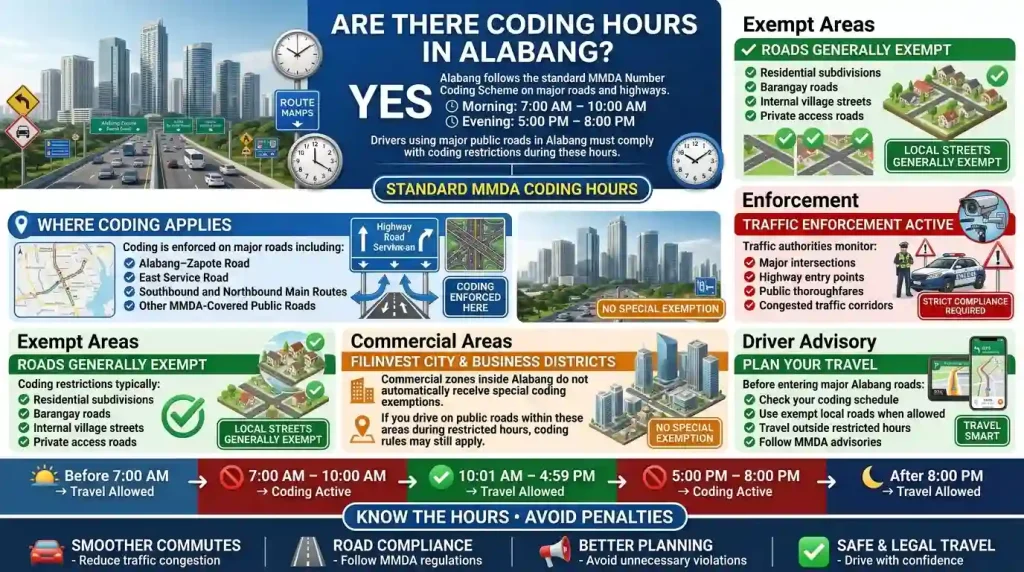
Quick Answer: Alabang in Muntinlupa enforces coding on major roads like Alabang-Zapote Road and the East Service Road. The schedule follows standard MMDA hours: 7:00 AM to 10:00 AM and 5:00 PM to 8:00 PM.
Residential streets and smaller roads in Alabang are generally exempt. If you stay within the subdivisions and barangay roads, coding does not apply. But once you enter the main highways, you are subject to the scheme.
Filinvest City and similar commercial areas within Alabang do not have separate exemptions. Coding applies uniformly on public roads during the restricted hours.
What Are the Coding Hours in Quezon City?
Quick Answer: Quezon City follows the standard MMDA coding schedule: 7:00 AM to 10:00 AM and 5:00 PM to 8:00 PM. Window hours are 10:01 AM to 4:59 PM on weekdays.
Major roads like Commonwealth Avenue, Quezon Avenue, and EDSA within QC limits enforce this strictly. Traffic enforcers set up checkpoints at key intersections during peak hours. If you live in QC, avoid these main roads on your coding day or travel during the window.
Does Pasig Have Different Coding Hours?
Quick Answer: No, Pasig follows the standard MMDA schedule. Coding hours are 7:00 AM to 10:00 AM and 5:00 PM to 8:00 PM. Window hours are 10:01 AM to 4:59 PM.
Pasig enforces coding on Ortigas Avenue, C-5, and other major roads. The city has several business districts, so expect active enforcement during rush hours.
Is BGC Exempt from Number Coding?
Quick Answer: Yes, Bonifacio Global City in Taguig is exempt from the number coding scheme. You can drive through BGC on your coding day without penalty.
BGC operates its own traffic management system separate from Taguig’s enforcement of MMDA coding. The exemption applies to all roads within BGC proper, including 32nd Street, 5th Avenue, and Bonifacio High Street.
But once you exit BGC and enter national roads like C-5 or McKinley Road, coding rules apply again. The exemption only covers the BGC area itself.
What Does “Hour of Code” Mean in the Context of Blox Fruits?
Quick Answer: “Hour of Code 2x EXP Blox Fruits” refers to promotional codes in the online game Blox Fruits that give double experience points for one hour. This is unrelated to the Metro Manila traffic coding scheme.
Players search for terms like “2x exp codes Blox Fruits 1 hour” to find temporary boosts. These codes are released by the game developers during special events. They have nothing to do with vehicle restrictions in the Philippines.
If you landed on this article looking for game codes, you are in the wrong place. This guide covers traffic regulations, not gaming.
Who Should Participate in the Hour of Code Initiative?
Quick Answer: The “Hour of Code” education initiative by Code.org is a global movement where students spend one hour learning basic computer programming. It is unrelated to Metro Manila’s vehicle coding scheme.
Schools, teachers, and students participate in Hour of Code events to promote coding literacy. The program introduces kids to programming through interactive tutorials and games. It has nothing to do with traffic management in the Philippines.
That said, the term “hour of code” in a Philippine traffic context refers exclusively to the number coding scheme. Do not confuse the two.
How to Avoid Coding Violations: Practical Tips
Plan trips around coding hours. If you know your vehicle is coded on Wednesday, schedule appointments and errands for other days or during the window period. That is the simplest way to avoid fines.
Use alternative routes through residential streets. Many neighborhoods have side roads that bypass major thoroughfares. These are less likely to have enforcers. But be cautious — some cities still apply coding even on smaller roads.
Consider carpooling. If you need to travel on your coding day, ride with a colleague or family member whose vehicle is not coded. Carpooling reduces traffic and helps you stay legal.
Check announcements daily. Coding suspensions happen more often than you might think. Always verify the status before heading out. A quick scroll through MMDA social media takes 30 seconds.
Tip:
Set a recurring phone reminder for 6:00 AM on weekdays. Check MMDA Facebook or Twitter for any coding suspension announcement. This habit takes less than a minute and can save you from a ₱1,000 fine.
What Are the Long-Term Plans for Metro Manila Traffic Management?
The national government is investing in mass transit projects to reduce reliance on private vehicles. The Metro Manila Subway, new LRT extensions, and the North-South Commuter Railway aim to absorb millions of commuters currently using cars.
Once these systems are operational, the MMDA may revisit the coding scheme. Some officials have proposed lifting coding entirely if public transport improves enough to handle demand. But that is years away. For now, expect the scheme to remain in place.
There is also talk of implementing congestion pricing in key areas like Makati and BGC. This would charge vehicles a fee to enter high-traffic zones during peak hours. Singapore and London use similar systems. If adopted, it could replace or supplement the coding scheme.